
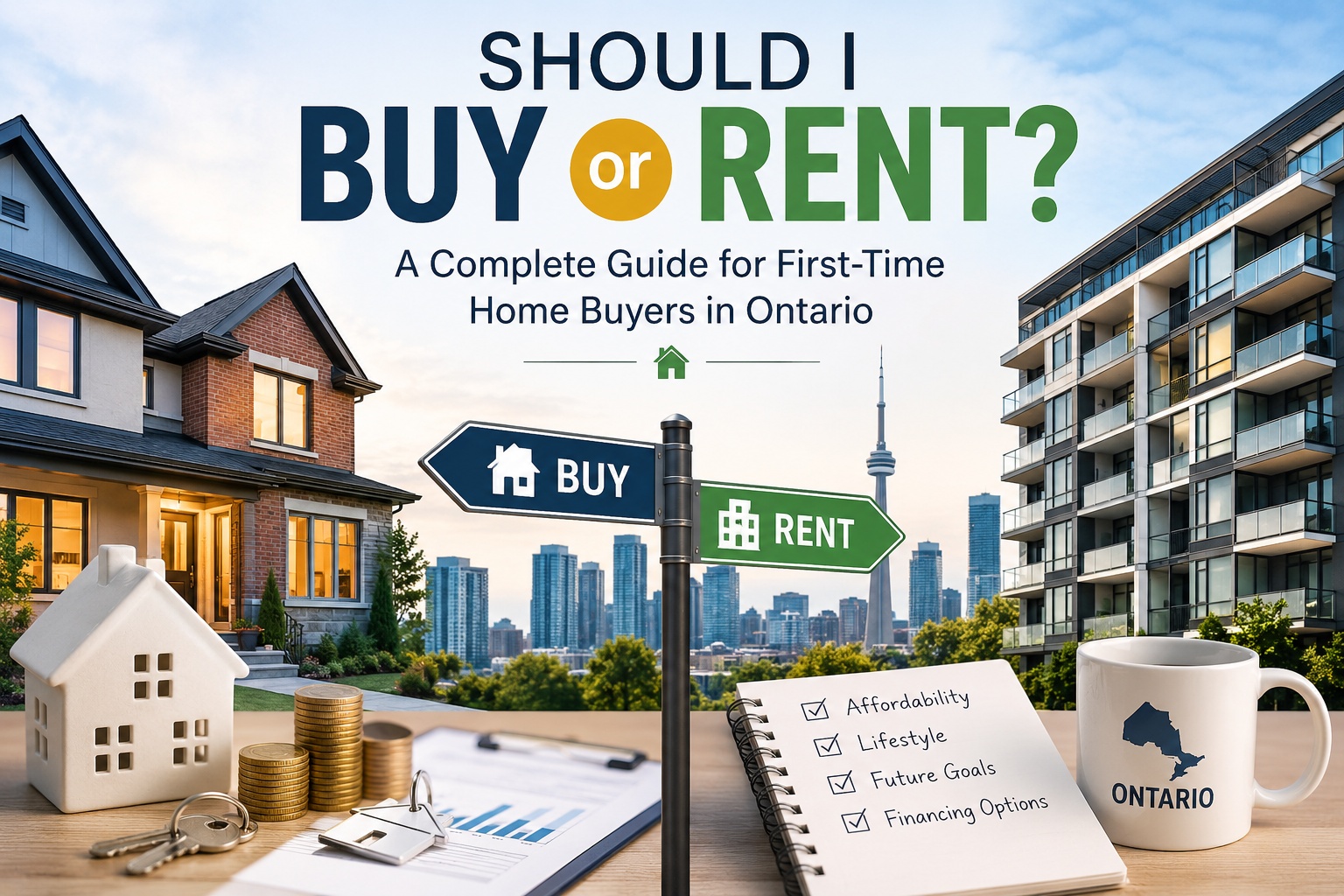

CaptionFirst-Time Buyer Guide · Ontario · 2026Should I Buy or Rent in Ontario?The complete first-time home buyer's guide — true costs, affordability, and the myths worth ignoring
First-Time Buyer Guide · Ontario · 2026
Should I Buy or Rent in Ontario?
The complete first-time home buyer's guide — true costs, affordability, and the myths worth ignoring.

Buying your first home is one of the biggest financial decisions you'll ever make. If you're like many Ontarians, you've probably asked yourself whether it's time to stop renting and finally buy.
"Should I continue renting, or is it finally time to buy a home?"
With rising home prices, changing mortgage rates, increasing rents, and economic uncertainty, it's understandable that many first-time buyers feel overwhelmed. The good news? There isn't a universal answer — but there is a right answer for your financial situation, lifestyle, and long-term goals.
Many renters assume homeownership is out of reach. Others rush into buying before they're financially prepared. Both decisions can become expensive mistakes. Whether you're eyeing a condo in Waterloo, a detached home in Cambridge, or a townhouse in Kitchener, this guide will help you make a confident, informed decision.
Ontario Housing Market Snapshot
Ontario's housing market has become more balanced compared to the frenzied conditions of previous years. Buyers now have more inventory to choose from, giving them greater negotiating power in many communities. Meanwhile, rental prices continue to climb due to strong immigration, limited supply, and sustained demand — which raises the question of whether renting or buying offers better long-term value.
Buying vs. Renting: What's the Difference?
Many people compare monthly rent directly with a monthly mortgage payment — but that comparison is incomplete. Here's the real distinction:
Renting
- A place to live
- Flexibility
- Minimal maintenance duties
- Short-term commitment
- No equity built
Buying
- Homeownership
- Equity built over time
- Potential appreciation
- Greater stability
- Maintenance & tax responsibility
The True Cost of Renting
Renting often looks cheaper because the upfront costs are lower — typically first and last month's rent, tenant insurance, and moving expenses. Monthly costs are usually just rent, utilities, internet, and tenant insurance.
Advantages of renting
- Lower upfront costs — no down payment, legal fees, or land transfer tax.
- Greater flexibility — easier to relocate for jobs or lifestyle changes.
- Predictable maintenance — repairs are generally the landlord's responsibility.
- Lower financial risk — less exposure to market swings and surprise repairs.
The downsides
- No equity — five years at $2,200/month is roughly $132,000 paid with no asset to show for it.
- Rent increases — rent control has exemptions, and costs often jump when moving to a new unit.
- Limited personalization — most leases restrict painting or renovations.
- Housing uncertainty — owner occupancy, sales, or renovations can force a move.
The True Cost of Buying
Buying involves more than a mortgage payment. Monthly ownership costs often include the mortgage itself, property taxes, utilities, home insurance, maintenance, landscaping, and condo fees where applicable. Many first-time buyers underestimate these ongoing expenses — but unlike rent, a portion of every payment builds equity in an asset that's yours.
What Is Home Equity?
Equity is one of the greatest financial advantages of owning a home.
Equity = Home Value − Remaining Mortgage Balance
Purchase price$650,000
Mortgage$600,000
Starting equity$50,000
As you make payments — and if your home's value rises — that equity can grow, later helping fund another home purchase, an investment, education, or a renovation.
Why Many Experts Recommend Buying — When You're Ready
- Building wealth — through principal repayment and potential appreciation.
- Stable housing costs — a fixed-rate mortgage keeps payments predictable during the term.
- Pride of ownership — freedom to landscape, renovate, and make the space your own.
- Potential appreciation — never guaranteed, but real estate has historically built long-term wealth for Canadian families.
How Much Down Payment Do You Need?
One of the biggest myths is that you need 20% down. That's not necessarily true — many first-time buyers purchase with a much smaller down payment, though anything under 20% generally requires mortgage default insurance, which raises borrowing costs but improves accessibility. The right number depends on your budget and long-term goals, not just the minimum required.
Coming up in Part 2
Cost comparisons, mortgage affordability, first-time buyer incentives, common mistakes, and a full FAQ for Ontario buyers.
 Toronto Real Estate Board (TRREB); All information deemed reliable but not guaranteed. All properties are subject to prior sale, change or withdrawal. Neither listing broker(s) or information provider(s) shall be responsible for any typographical errors, misinformation, misprints and shall be held totally harmless. Listing(s) information is provided for consumer's personal, non-commercial use and may not be used for any purpose other than to identify prospective properties consumers may be interested

 Data provided by the Ontario Regional Technology & Information Systems. The information is deemed reliable, but is not guaranteed. Not intended to solicit buyers or sellers, landlords or tenants currently under contract.
The trademarks REALTOR®, REALTORS® and the REALTOR® logo are controlled by The Canadian Real Estate Association (CREA) and identify real estate professionals who are members of CREA. The trademarks MLS®, Multiple Listing Service® and the associated logos are owned
Data provided by the Ontario Regional Technology & Information Systems. The information is deemed reliable, but is not guaranteed. Not intended to solicit buyers or sellers, landlords or tenants currently under contract.
The trademarks REALTOR®, REALTORS® and the REALTOR® logo are controlled by The Canadian Real Estate Association (CREA) and identify real estate professionals who are members of CREA. The trademarks MLS®, Multiple Listing Service® and the associated logos are owned
 All information deemed reliable but not guaranteed. All properties are subject to prior sale, change or withdrawal. Neither listing broker(s) or information provider(s) shall be responsible for any typographical errors, misinformation, misprints and shall be held totally harmless. Listing(s) information is provided for consumer's personal, non-commercial use and may not be used for any purpose other than to identify prospective properties consumers may be interested in purchasing. The data relating